Every spring, gardeners spend a fortune on fertilizer. Synthetic nutrients, slow-release granules, liquid feeds — all designed to feed the plant directly. And it works, to a point. But here's what most of that fertilizer isn't doing: it's not feeding your soil. And your soil is where everything actually starts.
Beneath your garden right now is an ecosystem — billions of microorganisms breaking down organic matter, cycling nutrients, suppressing disease, building the kind of ground that makes plants want to grow. Compost tea is one of the simplest, cheapest, and most effective ways to feed that ecosystem directly.
What Is Compost Tea and Why Does It Work?
Compost tea is a liquid amendment brewed from compost — steeped and aerated in water over time. The goal isn't just to extract nutrients. The goal is to grow the microbial population living inside the compost and deliver it directly to your soil and plants. A teaspoon of healthy garden soil can contain more microorganisms than there are people on Earth — bacteria, fungi, nematodes, protozoa — all working constantly beneath the surface.
The benefits are real: improved soil structure, better water retention, enhanced nutrient cycling, suppression of certain soil-borne pathogens, and stronger root development. What separates compost tea from simply watering with compost is the aeration. That's what drives the microbial multiplication. That's what makes it worth doing.
Why Aeration and Timing Are Everything
The beneficial microorganisms that make compost tea useful — the bacteria and fungi that improve soil structure, support nitrogen cycling, and suppress pathogens — are aerobic. They require oxygen to survive and reproduce. Without it, they die off and are replaced by anaerobic bacteria, some of which produce compounds that can actually harm your plants and soil.
The pump isn't optional. It's the whole mechanism. And timing matters critically:
- Under 24 hours — the microbial population hasn't had enough time to multiply. You'll have tea, but not potent tea.
- 24 to 48 hours — the sweet spot. Biology is active, oxygen levels are maintained, beneficial microorganisms are at peak concentration.
- Over 48 hours — even with aeration, the oxygen demand of the expanding population begins to outpace the pump. Anaerobic conditions develop. What you've brewed can stress your plants rather than support them.
Use it immediately when done. This is not something you make and store. Once you stop aerating, you have hours — not days — before the biology degrades. Make it. Use it.
Temperature Requirements
Below 50°F, microbial activity slows dramatically. You can run the pump all day and get minimal biological multiplication. The ideal brewing temperature is 65 to 75°F — warm enough for efficient microbial growth, not so warm that oxygen depletes quickly. In New England, that means this is a warm-weather practice: spring through fall, once temperatures are consistently above 50. Or brew it indoors if you want to start earlier in the season.
What You Need
- 5-gallon bucket
- Commercial-grade air pump (Active Aqua AAPA15L or equivalent — four outlets, high air volume)
- Silicone tubing — not vinyl, which can leach compounds into the brew
- A rock or weight to hold the hose ends at the bottom of the bucket
- 5-gallon nylon mesh paint strainer bag
- Composted cow manure (~2 cups)
- Worm castings (a generous scoop)
- Room temperature, dechlorinated water — municipal water needs to sit uncovered a few hours to off-gas chlorine, or use rainwater
Step-by-Step: How to Brew It
- Prepare your water. Fill your bucket with room temperature water. If you're on municipal water, let it sit uncovered for a few hours to off-gas chlorine first. Chlorine is designed to kill microorganisms — it will kill the ones you're trying to grow. Rainwater is even better if you have it.
- Load the strainer bag. Add approximately 2 cups of composted cow manure and a generous scoop of worm castings into the paint strainer bag. Worm castings are the premium input here — among the most biologically rich composts available, dense with beneficial microorganisms, enzymes, and humic acids. Lower the bag into the bucket.
- Weight the hoses. Attach your silicone hoses to the pump outlets and tie a rock to the ends. This keeps the hoses on the floor of the bucket so aeration happens through the full water column — not just the surface.
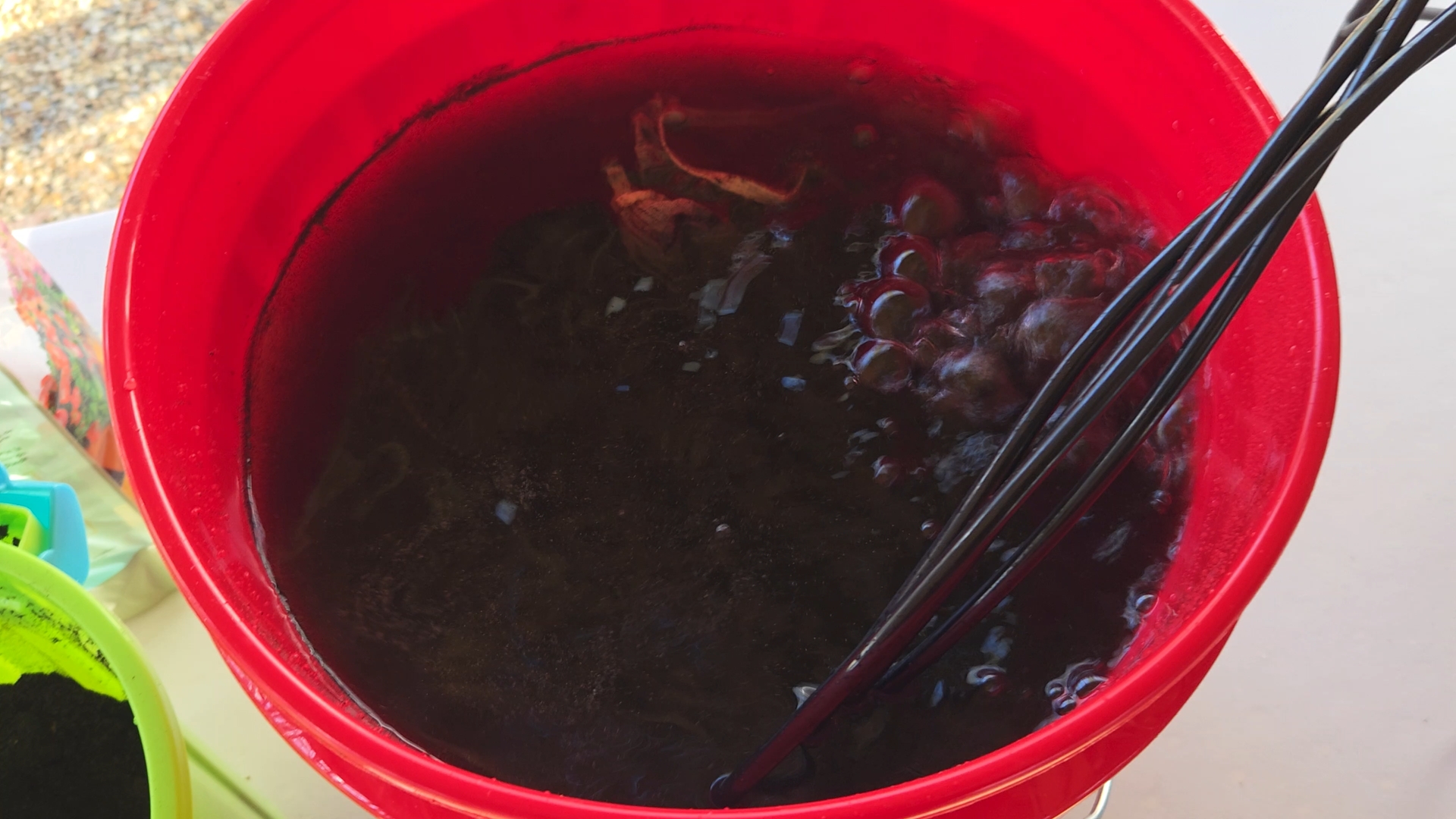
- Start the pump. You should see active bubbling throughout the water, not just at the surface. If activity is only happening near the top, reposition the hoses.
- Brew for 24 to 48 hours. Keep the pump running continuously. Don't stop early, don't let it go past 48 hours.
- Pull the bag and use immediately. Remove the strainer bag — the spent compost goes directly into a garden bed, nothing wasted. What remains is a rich, brown, living liquid. Apply it right away.
How to Apply It
Soil drench — Apply directly to the root zone of vegetables, flowers, and fruit trees. This is where the biology needs to establish in the soil. Fruit trees in particular respond well; orchard soils deplete over time and a compost tea drench in spring and again mid-season keeps the biology active where the roots are working.
Pre-planting treatment — Treat your garden beds with compost tea before anything goes in the ground. You're inoculating the soil with beneficial biology before you're asking it to support plants. Build the environment first, then plant into it.
Foliar spray — Diluted compost tea applied to leaf surfaces introduces beneficial microorganisms that compete with and suppress foliar pathogens like powdery mildew. Spray in the morning so leaves have time to dry before nightfall — wet leaves overnight creates its own problems.
One Important Caveat
Compost tea is not a replacement for good soil. It amplifies good soil. If you're working with genuinely depleted or compacted ground, start with physical amendment — compost turned in, organic matter added — and use the tea as part of your maintenance routine going forward. It's a supplement to a healthy system, not a rescue for a broken one.
The setup is simple. The biology is real. And the results — healthier soil, stronger plants, better yields — are the kind of thing you notice over a full season, not overnight. But that's how gardening works. You invest in the ground, and the ground gives back.
Whatever you're growing this season — grow it well.